


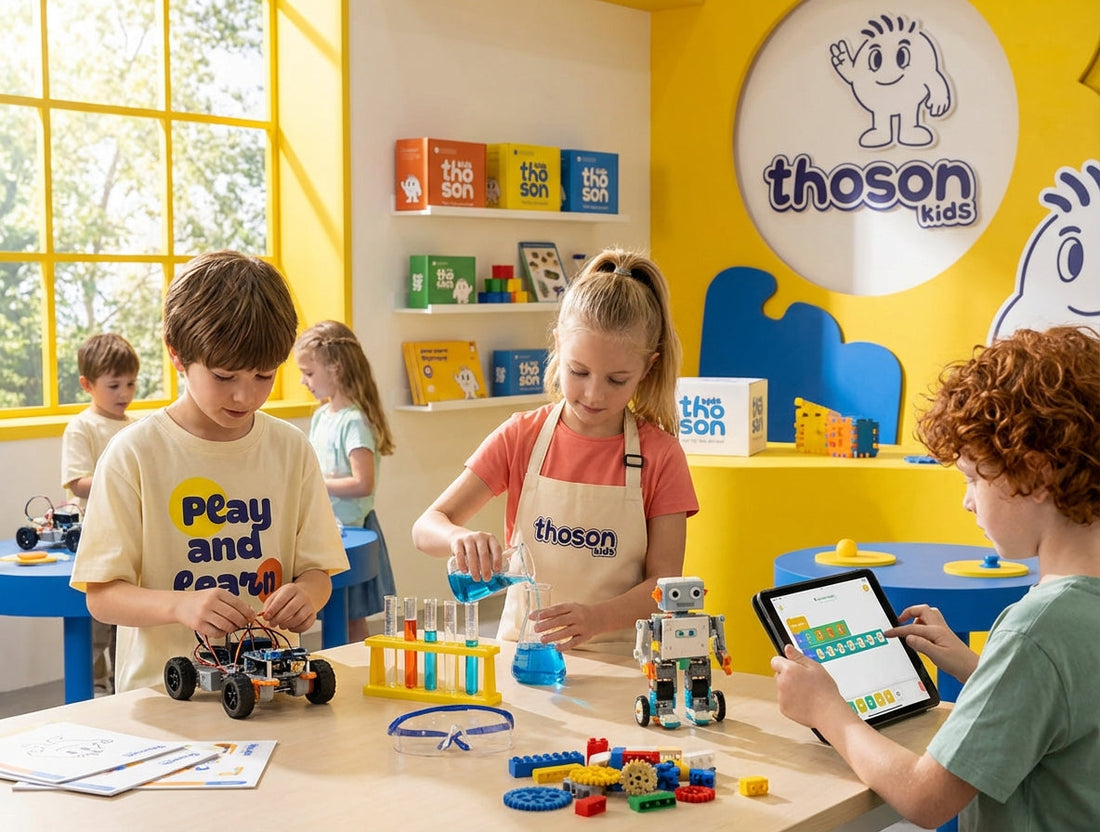
STEM toys for kids, those focusing on Science, Technology, Engineering, and Mathematics, have exploded in popularity as parents recognize the critical importance of these skills for future success. But not all toys labeled "STEM" deliver genuine learning. Many are simply repackaged products with science buzzwords slapped on the packaging, offering little more than entertainment value.
The best STEM toys for kids don't feel like "education": they feel like discovery. Children experiment, build, problem-solve, and iterate naturally, developing critical thinking skills and genuine scientific understanding without realizing they're learning. From building circuits to coding robots, from chemistry experiments to engineering challenges, quality STEM toys transform abstract concepts into hands-on, engaging experiences.
This comprehensive guide cuts through marketing hype to identify STEM toys that genuinely teach. We've consulted education research, STEM curriculum standards, and child development principles to bring you evidence-based recommendations that work.
In this guide, you'll discover:
- What makes a toy genuinely "STEM" vs. marketing
- 15 categories of the best STEM toys for different ages
- How STEM toys build future-ready skills
- Age-appropriate STEM toy recommendations
- The science behind learning through STEM play
- Budget-friendly STEM options
- Red flags in STEM toy marketing
Table of Contents
What Makes a Toy Truly STEM?

The term "STEM" has become so overused in toy marketing that it's nearly meaningless. Understanding what genuinely qualifies as STEM helps you identify toys that actually teach versus those that simply capitalize on a buzzword.
The Four STEM Domains
S - Science
What it is: Understanding natural phenomena through observation, experimentation, and analysis
What it looks like in toys:
- Experimentation kits (chemistry, physics, biology)
- Nature exploration tools (microscopes, telescopes)
- Cause-and-effect toys that demonstrate scientific principles
- Weather tracking, plant growing, animal observation
Not science: Toys that simply have science-themed decorations without actual scientific exploration
T - Technology
What it is: Using and understanding tools, machines, and systems to solve problems
What it looks like in toys:
- Coding toys and games
- Simple machines (gears, pulleys, levers)
- Electronics and circuits
- Computer programming introduction
Not technology: Electronic toys that require no understanding of how they work
E - Engineering
What it is: Designing, building, and testing solutions to problems
What it looks like in toys:
- Building and construction sets
- Robotics kits
- Engineering challenge games
- Architectural toys
Not engineering: Following instructions to build one predetermined model with no design thinking
M - Mathematics
What it is: Understanding patterns, relationships, quantities, and spatial reasoning
What it looks like in toys:
- Pattern recognition games
- Spatial puzzles
- Measurement and estimation activities
- Logic and strategy games
Not math: Flashcards that drill number recognition without understanding
Characteristics of Genuine STEM Toys
1. Hands-On Experimentation
True STEM toys require active manipulation, testing, and discovery. Children should be DOING science/engineering/math, not watching or memorizing.
2. Open-Ended Problem Solving
The best STEM toys present challenges with multiple possible solutions, encouraging creative problem-solving and iteration.
3. Failure as Learning
Quality STEM toys allow (and expect) failure as part of the learning process. Bridges collapse, experiments fail, code has bugs, and children learn from each iteration.
4. Real Scientific/Engineering Process
Genuine STEM toys mirror actual STEM work:
- Question: What will happen if...?
- Hypothesis: I think... because...
- Experiment: Try it out
- Observe: What actually happened?
- Analyze: Why did it work/not work?
- Iterate: Try again with modifications
5. Builds Transferable Skills
The best STEM toys teach thinking skills that transfer beyond the specific toy:
- Critical thinking
- Systematic problem-solving
- Spatial reasoning
- Logical thinking
- Persistence through challenges
Why STEM Skills Matter More Than Ever
STEM education isn't just about preparing children for STEM careers (though that's valuable). STEM toys build foundational thinking skills essential for success in ANY field.
Where STEM Play Leads
Hands-on STEM play gives a child things that keep paying off:
- Comfort with math and science that grows through play rather than pressure
- A widening range of fields where curiosity about how things work is genuinely useful
- Habits of investigation that transfer to almost any kind of work
- The sense that science and engineering are places they can belong
Universal Skills STEM Toys Build
Critical Thinking
STEM play teaches children to analyze situations, evaluate options, and make evidence-based decisions, skills valuable in every life domain.
Problem-Solving
Breaking large problems into manageable steps, testing solutions systematically, and iterating based on results. These skills apply far beyond science class.
Resilience and Persistence
STEM toys normalize failure as part of learning. Children develop the persistence to work through difficult challenges rather than giving up at the first obstacle.
Creativity and Innovation
Contrary to stereotypes, STEM requires enormous creativity. The best solutions often come from thinking differently and trying unconventional approaches.
Logical Thinking
STEM play builds "if-then" reasoning, understanding cause-and-effect, and predicting outcomes, all essential for sound judgment.
Early STEM Exposure Matters
Research consistently shows that:
- Children who engage with STEM concepts early demonstrate stronger STEM skills throughout school
- Early positive STEM experiences increase likelihood of pursuing STEM education and careers
- The "I'm not a math/science person" mindset often forms by age 10, and early exposure builds confidence
- Gender gaps in STEM interest emerge as early as age 6, and early exposure helps prevent these gaps
STEM Toys by Age: Developmental Approach
STEM learning should match developmental capabilities. Here's what children can handle at each age:
Preschool (Ages 3-5)
Developmental capabilities:
- Concrete, hands-on learning only (no abstract concepts)
- Cause-and-effect understanding
- Basic categorization and sorting
- Simple patterns
- Beginning problem-solving
Best STEM toys:
- 🔗 Building blocks and construction toys
- Simple machines (ramps, pulleys, gears)
- Magnets exploration
- Nature observation tools
- Basic sorting and pattern games
- Water and sand exploration
Early Elementary (Ages 6-8)
Developmental capabilities:
- Following multi-step instructions
- Understanding simple abstract concepts
- Planning ahead
- Reading instructions independently
- More complex problem-solving
Best STEM toys:
- Beginning coding toys (screen-free)
- Simple electronics kits (circuits, lights)
- Robotics kits (basic)
- Science experiment kits
- Advanced building sets (moving parts)
- 🔗 Thoson MicroScope Explorer™
Upper Elementary (Ages 9-12)
Developmental capabilities:
- Abstract thinking emerging
- Understanding complex systems
- Working independently on projects
- Following detailed instructions
- Sustained focus on challenging tasks
Best STEM toys:
- Advanced robotics
- Computer programming
- Chemistry and physics kits
- Engineering challenges
- 3D modeling and printing
- Electronics projects
Middle School (Ages 12+)
Developmental capabilities:
- Full abstract thinking
- Understanding theoretical concepts
- Independent research and learning
- Complex multi-step projects
Best STEM tools:
- Advanced programming platforms
- Serious robotics (competitions)
- Real scientific equipment
- Engineering software
- Advanced electronics
15 Best Categories of STEM Toys for Kids
1. Building and Construction Sets

Why they're fundamental STEM: Building toys teach engineering principles, spatial reasoning (one of the better predictors of STEM success), mathematical concepts, and problem-solving through direct, hands-on experience.
STEM skills developed:
- Engineering: Structural stability, design thinking, problem-solving, iteration
- Math: Spatial reasoning, symmetry, proportion, measurement, counting
- Science: Physics principles (gravity, balance, force), material properties
- Technology: Understanding how structures and machines work
What block play builds: Children who build regularly with blocks tend to develop strong spatial thinking, early mathematical understanding, and an intuitive feel for how structures hold together.
Best building sets for STEM:
Ages 3-5:
- Wooden unit blocks: Open-ended, teach fundamental physics
- Large building bricks: Interlocking pieces, stable structures
- Magnetic tiles: Easy connection, 3D thinking, light exploration
- 🔗 Thoson Blocks - Full Pack™
Ages 6-8:
- Building systems with gears/wheels: Moving parts add complexity
- Architectural sets: Specific building challenges
- Marble runs: Physics experiments with momentum, gravity
- 🔗 Thoson MagTrack™ for magnetic construction with track elements
Ages 9+:
- Advanced engineering sets
- Mechanical systems (motors, gears)
- Model building with working mechanisms
The STEM power of building: Unlike passive STEM toys, building sets require children to plan, execute, observe results, troubleshoot problems, and iterate: the complete engineering design process in action.
2. Coding and Programming Toys

Why coding matters for kids: Coding teaches computational thinking: breaking problems into steps, creating sequences, debugging errors. These skills transfer far beyond computer programming.
Skills developed:
- Technology: Understanding how programs work
- Math: Sequential thinking, logic, patterns, cause-and-effect
- Problem-solving: Debugging (finding and fixing errors)
- Planning: Thinking ahead in sequences
Screen-free coding toys (ages 4-8):
- Robot mice/bees: Program with buttons, watch robot execute commands
- Coding board games: Learn programming concepts through physical play
- Floor robots: Program paths with directional cards
- Sequence games: Building block-based programs
Screen-based coding (ages 7+):
- Block-based programming: Visual programming languages (Scratch)
- App-controlled robots: Program robots through tablet apps
- Game creation platforms: Build simple games
Text-based coding (ages 10+):
- Python programming
- JavaScript
- Web development basics
Coding progression:
- Sequences: Commands in order
- Loops: Repeating actions
- Conditionals: If-then statements
- Variables: Storing information
- Functions: Reusable code blocks
Key principle: Start screen-free to build foundational concepts, then progress to screen-based programming as children mature.
3. Robotics Kits
Why robotics are ultimate STEM: Robotics integrates all four STEM domains: science (sensors, physics), technology (programming), engineering (building mechanisms), and math (measurements, calculations).
Skills developed:
- Mechanical engineering (building robot structure)
- Electrical engineering (circuits, sensors)
- Programming (making robot perform tasks)
- Problem-solving (debugging when things don't work)
- Creativity (designing unique solutions)
Robotics by age:
Ages 5-7: Beginner Robots
- Pre-programmed robots with simple controls
- Basic programming (button sequences)
- Minimal building required
- Focus on cause-and-effect, sequencing
Ages 8-10: Intermediate Robotics
- Building + programming combined
- Block-based programming
- Sensors and motors
- Solving specific challenges
Ages 11+: Advanced Robotics
- Complex builds with multiple components
- Text-based or advanced programming
- Competition-ready robots
- Custom projects
What to look for:
- Age-appropriate complexity
- Good instructions (but allow experimentation)
- Expandable (can add sensors, parts)
- Active user community (online tutorials, ideas)
4. Science Experiment Kits
Why experiment kits work: Hands-on experiments make abstract scientific concepts concrete and memorable. Children who do science remember far more than they do from reading about it.
Best experiment kits by domain:
Chemistry:
- Ages 6-8: Safe reactions (baking soda + vinegar), crystal growing, color mixing
- Ages 9-12: Acids/bases, chemical reactions, molecule models
- Ages 12+: More advanced chemistry with proper safety equipment
- Key concepts: States of matter, reactions, properties of materials
Physics:
- Ages 6-8: Simple machines, magnets, light and color, sound
- Ages 9-12: Electricity, motion and force, energy, circuits
- Key concepts: Cause-and-effect, energy transfer, forces
Biology:
- Ages 6-8: Plant growth, insect observation, human body basics
- Ages 9-12: Microscope work, dissection (virtual or real), ecosystems
- Key concepts: Life cycles, adaptation, systems
Earth Science:
- Weather observation and tracking
- Rock and mineral identification
- Geology experiments (erosion, earthquakes)
- Astronomy (telescopes, star maps)
Critical feature: Best kits explain WHY experiments work, not just HOW to do them. Understanding the science matters more than impressive results.
5. Electronics and Circuits
Why electronics are essential STEM: Understanding circuits and electricity is foundational for modern technology literacy. Plus, making lights turn on is genuinely exciting for kids!
Skills developed:
- Understanding electricity flow
- Circuit design
- Problem-solving (troubleshooting circuits)
- Following diagrams and schematics
- Creative engineering
Electronics toys by age:
Ages 6-8: Snap Circuits
- Color-coded pieces snap together (no wiring)
- Follow diagram to build working circuits
- Make lights, sounds, motors work
- Safe introduction to electronics
- Teaches basic circuit concepts
Ages 9-12: Advanced Circuits
- More complex components (transistors, capacitors)
- Integrated circuits (ICs)
- Audio circuits
- Light and sound projects
Ages 12+: Arduino and Microcontrollers
- Programmable electronics
- Sensors and outputs
- Custom projects
- Real engineering-level work
Safety note: Always supervise electronics work. Use low-voltage kits designed for children. Never work with household electrical current.
6. Microscopes and Telescopes
Why observation tools matter: Scientific observation is a fundamental skill. Tools that enhance observation teach children to look closely, notice details, and ask questions.
Microscopes:
Ages 6-8: Beginner Microscopes
- 20-40x magnification
- Sturdy construction (will be dropped!)
- LED lighting
- Prepared slides included
- 🔗 Thoson MicroScope Explorer™ for beginning scientific observation
Ages 9-12: Intermediate Microscopes
- 40-400x magnification
- Multiple objectives
- Slide preparation tools
- Quality optics
What to observe:
- Prepared slides (insects, plants, crystals)
- Pond water (microorganisms!)
- Plant cells (onion skin)
- Fabric fibers
- Salt and sugar crystals
- Hair and skin cells
Telescopes:
Ages 7-10: Beginner Telescopes
- Refractor style (easier to use)
- 50-70mm aperture
- Stable mount
- Moon, planets, bright stars
Ages 11+: Advanced Telescopes
- Larger aperture (more light gathering)
- Reflector or compound designs
- Tracking mounts
- Deep sky observation
Astronomy activities:
- Moon phase tracking
- Planet observation
- Constellation identification
- Star mapping
- Meteor shower watching
7. Math Manipulatives and Logic Games
Why hands-on math matters: Mathematical concepts become concrete through physical manipulation. Using manipulatives helps children build deeper number sense and mathematical understanding than paper work alone.
Essential math manipulatives:
Ages 4-6:
- Counting bears or counters
- 🔗 Count Crew - Full Pack™
- Pattern blocks
- Unifix cubes (snap together)
- Number lines
Ages 6-8:
- Base-ten blocks (place value)
- Fraction tiles or circles
- Geoboards (spatial geometry)
- Tangrams
- Measurement tools (rulers, scales, measuring cups)
Ages 9+:
- Algebra tiles
- 3D geometric solids
- Protractors and compasses
- Advanced fraction manipulatives
Logic and strategy games:
- Pattern games: Recognizing and continuing patterns
- Sudoku: Logic, number relationships
- Chess: Strategic thinking, planning ahead
- Logic puzzles: Deductive reasoning
- Strategy board games: Planning, probability
8. Engineering Challenge Sets
Why challenges work: Open-ended engineering challenges teach design thinking: the process of identifying problems, brainstorming solutions, building prototypes, testing, and iterating.
Types of engineering challenges:
Structural Engineering:
- Build tallest tower with limited materials
- Create bridge that holds weight
- Design earthquake-resistant structure
- Build chair that supports weight
Materials provided: Straws, popsicle sticks, tape, rubber bands, paper, cardboard
Mechanical Engineering:
- Design vehicle that travels farthest
- Create catapult for distance/accuracy
- Build pulley system to lift weight
- Design Rube Goldberg machine
The engineering design process:
- Ask: What's the problem? What are the constraints?
- Imagine: Brainstorm possible solutions
- Plan: Choose best idea, draw design
- Create: Build prototype
- Test: Does it work? How well?
- Improve: What can be better? Rebuild and retest
Why this matters: This is exactly how professional engineers work. Children learning this process gain problem-solving skills applicable to any challenge.
9. 3D Puzzles and Spatial Reasoning Toys
Skills: Spatial intelligence (one of the better predictors of STEM success), visual-spatial reasoning, mental rotation
- 3D building puzzles
- Tangrams and pattern blocks
- Rubik's cubes
- Architectural puzzles
10. Crystal Growing and Chemistry Kits
Skills: Patience, observation, chemical reactions, states of matter
- Crystal growing kits
- Safe chemistry experiments
- Slime and polymer science
11. Magnet Exploration Sets
Skills: Force, attraction/repulsion, scientific observation
- Magnetic building tiles
- Magnet experiment kits
- Magnetic levitation toys
12. Weather and Earth Science Tools
Skills: Data collection, pattern recognition, meteorology, earth systems
- Weather stations
- Rain gauges and thermometers
- Rock and mineral kits
13. Simple Machines Learning Sets
Skills: Mechanical advantage, physics, engineering
- Pulley systems
- Lever and fulcrum sets
- Gear mechanisms
- Inclined planes (ramps)
14. Coding Board Games (Screen-Free)
Skills: Computational thinking, sequencing, debugging
- Robot programming games
- Code-and-go mice/bees
- Sequence-building card games
15. Math and Pattern Games
Skills: Number sense, pattern recognition, logical thinking
- Pattern recognition games
- Number strategy games
- Geometry and spatial games
Breaking Barriers: STEM Toys for Girls

The problem: By age 6, many girls already believe "boys are better at science and math." By middle school, girls' interest in STEM careers drops significantly. This isn't about ability: it's about exposure, encouragement, and stereotype threat.
The Research Is Clear
- Girls and boys have equal STEM aptitude in early childhood
- Gender gaps emerge from social expectations, not ability
- Girls who receive STEM encouragement early maintain STEM interest
- Female STEM role models significantly impact girls' STEM engagement
How to Support Girls in STEM
1. Don't Gender STEM Toys
All STEM toys are for all children. Avoid statements like "building toys are for boys" or steering girls toward "pink science kits." Offer identical STEM opportunities regardless of gender.
2. Celebrate Female STEM Role Models
Read books about women scientists and engineers. Watch documentaries. Talk about current female STEM leaders. Representation matters enormously.
3. Praise Effort and Strategy, Not "Being Smart"
Girls often receive praise for being "smart" or "careful," while boys get praise for "effort" and "strategy." This affects mindset. Say: "I love how you kept trying different approaches!" not "You're so smart!"
4. Normalize Struggle and Failure
Girls are more likely to give up when they encounter difficulty, viewing it as evidence they "aren't good at this." Explicitly teach that struggle is how we learn, failure is information, and persistence matters more than natural talent.
5. Avoid "Pink It and Shrink It"
Some companies create "science kits for girls" that are just regular kits in pink packaging with easier content. This is patronizing and suggests girls need different (lesser) content. Give girls the same challenging STEM toys as boys.
6. Counter Stereotypes Explicitly
When your daughter says "girls aren't good at math," counter it directly: "That's not true. Girls and boys are equally good at math. Some people believe that, but it's wrong. YOU can be excellent at math."
STEM Activities That Appeal to Many Girls
Note: These aren't "girl toys": they're STEM activities that research shows engage many girls:
- Real-world applications: How does this help people?
- Creative engineering: Design challenges with aesthetic elements
- Collaborative STEM: Team projects
- Biology and life sciences: Often high interest
- Environmental science: Conservation, sustainability
The goal: Every child deserves STEM opportunity. Don't let outdated stereotypes limit anyone's potential.
Budget-Friendly STEM Learning
Quality STEM learning doesn't require expensive kits. Many foundational STEM experiences cost little or nothing.
Free/Nearly Free STEM Activities
Engineering:
- Build with household recyclables (cardboard, bottles, containers)
- Create structures with toothpicks and marshmallows
- Design paper airplanes and test variables
- Build with sticks, leaves, rocks outdoors
Science:
- Kitchen chemistry (baking soda + vinegar reactions)
- Nature observation and collection
- Shadow experiments
- Plant growing from seeds
- Ice melting experiments
Math:
- Pattern hunts (find patterns in nature, home)
- Cooking (measuring, fractions)
- Board games (many teach math)
- Number scavenger hunts
Technology:
- Free coding websites (Code.org, Scratch)
- Take apart old electronics (supervise for safety)
- Design and test simple machines
Budget STEM Toy Options
- Building blocks: Classic wooden blocks (buy secondhand)
- Science experiments: Household items beat expensive kits
- Math manipulatives: Beans, buttons, pasta work perfectly
- Exploration tools: Magnifying glass is cheap but valuable
Library resources: Many libraries offer free science kits, maker spaces, and STEM programs. Check your local library!
STEM Marketing Red Flags to Avoid

Red Flag #1: "Makes Kids Smarter/Gifted"
Reality: No toy makes children "smarter." Quality STEM toys support learning, but claims of boosting IQ or creating geniuses are marketing hype.
Red Flag #2: Just Has "STEM" Label
Reality: Many toys slap "STEM" on packaging without actual STEM content. Check: Does it require active experimentation? Does it teach actual concepts?
Red Flag #3: One "Right" Answer
Reality: True STEM involves exploration and multiple solutions. If a toy only works one way with no room for experimentation, it's not genuine STEM learning.
Red Flag #4: Passive Entertainment
Reality: Toys that do everything for the child (flashy lights, automatic responses) aren't teaching. STEM requires active doing.
Red Flag #5: Age Acceleration Claims
Example: "Teaches calculus to preschoolers!"
Reality: Developmentally inappropriate content isn't beneficial. Match STEM toys to actual developmental capabilities.
Frequently Asked Questions
At what age should I start STEM toys?
STEM learning can start in toddlerhood! Ages 2-3 can explore cause-and-effect toys, building blocks, and nature observation. STEM thinking (observing, experimenting, problem-solving) is natural to young children, and STEM toys simply channel that curiosity.
Are expensive STEM toys better?
Not necessarily. Some expensive kits offer quality and longevity, but many free/cheap activities teach the same concepts. Household experiments, building with recyclables, and nature exploration cost nothing but provide genuine STEM learning. Invest in quality for items you'll use repeatedly (microscope, building sets), but don't feel expensive is necessary for STEM.
Do STEM toys really prepare kids for STEM careers?
STEM toys build thinking skills valuable in ANY career: problem-solving, critical thinking, persistence, logical reasoning. They also build familiarity and confidence with STEM concepts, making children more likely to pursue STEM if interested. But primarily, they teach universally valuable skills.
My child isn't interested in STEM toys. What do I do?
First, check that toys match developmental level and interests. Second, join them in STEM play initially, and model excitement and curiosity. Third, try different STEM domains: maybe coding doesn't appeal but chemistry does. Fourth, integrate STEM into existing interests (love dinosaurs? Paleontology is STEM!). Don't force, but offer repeated exposure.
Should I buy gender-specific STEM toys?
No. All STEM toys work for all children. Avoid "pink science kits for girls" or "engineering toys for boys." Research shows gendering STEM toys reduces engagement and reinforces stereotypes. Offer identical STEM opportunities regardless of gender.
If I can only buy one STEM toy, what should it be?
If forced to choose one category: building and construction sets. They teach engineering, math (spatial reasoning), physics, and problem-solving. They're open-ended, scale with development, and remain engaging for years. A quality building set covers a lot of STEM ground in a single purchase.
Are screen-based STEM toys okay?
In moderation, yes. Screen-based coding games and apps can teach genuine concepts. However, prioritize hands-on, physical STEM toys for younger children (under 8). Balance screen and screen-free STEM. The best learning comes from manipulating physical objects, not just virtual ones.
How do I know if a STEM toy is actually educational?
Ask: (1) Does it require active experimentation? (2) Does it allow multiple approaches/solutions? (3) Does it explain concepts, not just show cool effects? (4) Will it engage my child repeatedly? (5) Does it build transferable skills? If yes to most, it's likely genuine STEM.
Final Thoughts: STEM Toys That Actually Teach
The best STEM toys for kids don't announce themselves with flashy "STEM!" labels: they simply invite exploration, experimentation, and discovery. They're the building blocks that become towers, bridges, and cities. They're the experiment kits that make chemistry tangible. They're the coding toys that make programming logical. They're the tools that transform "I wonder..." into "Let's find out!"
Remember these core principles:
- Hands-on beats screen-based: Physical manipulation builds deeper learning
- Open-ended beats prescriptive: Multiple solutions encourage creativity
- Process beats product: Learning happens in the doing, not the final result
- Failure is feedback: Best STEM toys expect and embrace iteration
- Match development: Too easy bores, too hard frustrates
- STEM is for everyone: Every child deserves STEM opportunity
Most importantly, remember that your enthusiasm matters more than any toy. Children who see parents excited about STEM, asking questions, experimenting, wondering how things work, internalize that STEM is interesting, valuable, and accessible to them.
Ready to build a STEM toy collection that genuinely teaches? Explore 🔗 Thoson's hands-on STEM toys designed to spark curiosity, build skills, and make learning irresistible.